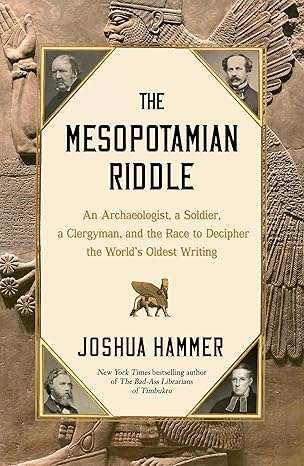


A rollicking adventure starring three free-spirited Victorians on a twenty-year quest to decipher cuneiform, the oldest writing in the world—from the New York Times bestselling author of The Bad-Ass Librarians of Timbuktu.
It was one of history’s great vanishing acts.
Around 3,400 BCE—as humans were gathering in complex urban settlements—a scribe in the mud-walled city-state of Uruk picked up a reed stylus to press tiny symbols into clay. For three millennia, wedge shape cuneiform script would record the military conquests, scientific discoveries, and epic literature of the great Mesopotamian kingdoms of Sumer, Assyria, and Babylon and of Persia’s mighty Achaemenid Empire, along with precious minutiae about everyday life in the cradle of civilization. And then…the meaning of the characters was lost.
London, 1857. In an era obsessed with human progress, mysterious palaces emerging from the desert sands had captured the Victorian public’s imagination. Yet Europe’s best philologists struggled to decipher the bizarre inscriptions excavators were digging up.
Enter a swashbuckling archaeologist, a suave British military officer turned diplomat, and a cloistered Irish rector, all vying for glory in a race to decipher this script that would enable them to peek farther back into human history than ever before.
From the ruins of Persepolis to lawless outposts of the crumbling Ottoman Empire, The Mesopotamian Riddle whisks you on a wild adventure through the golden age of archaeology in an epic quest to understand our past.
CW – sometimes detailed historical descriptions of torture of enslaved people
Review
I was promised “A rollicking adventure starring three free-spirited Victorians on a twenty-year quest.” I’m not sure that the person who wrote that actually read the book. The idea did sound interesting – recovering a once widely used writing system that had captured the events of mighty empires as well as science and literature in one of the cradles of civilization and then became lost to history as knowledge of it vanished. Imagine being one of the people to crack the mystery and give a world and its people back their voice. And to nineteenth century Europeans, solving the writing system might also allow corroboration of events mentioned in the Bible.
Hammer has obviously done his research. The book is packed with information about the ancient civilizations that used cuneiform writing (there were several including Sumerian, Akkadian, and Hittite among others) to record a king’s mighty deeds as he crushed his enemies (and, if you believe the Bible, the Assyrians earned Jonah’s message from God), as well as real estate sales contracts, a marriage contract, and one of the first works of literature. But wait, there’s more! What about the Victorian men (yep, mostly men and mostly white) who put years into figuring out what looked like bird footprints impressed on clay tablets? So, so much (too much?) information about them personally (not all were nice people or always did nice things and they were very much men of their time) as well as their places in the mid Victorian world. For another way to spend your time, look up “the Great Game.
Part of understanding what the men were up against is understanding the politics of their day which led to some of the wars and uprisings of the day as well as European plundering of artifacts of the day from places associated with cuneiform writing. Most of those attempting to unlock cuneiform used “stepping stones” to do that thanks to, among others, a giant cliffside trilingual show piece (the Behistun inscription) that King Darius the Great had had carved to brag about defeating a bunch of rebels (complete with images of him and his bound captives). Much like how the Rosetta stone’s three languages helped decipher Egyptian hieroglyphs, these men used extant/known languages to help figure out the Old Persian part, then finally moved on to Babylonian/Akkadian the language of Babylon, Nimrud, and Nineveh. Elamite took a while longer.
Other examples of cuneiform that helped them came from the ancient sites that several Europeans were busy looting – I mean excavating. I can almost see the British Ambassador to the Ottoman Empire rubbing his hands in glee at the thought of pipping the French to the post and overshadowing the Louvre. I’m glad that Hammer includes all this and points out how what actually happened was a far cry from the standard (European) thought of the day that all of these artifacts were obtained with full permission of the governments from which they were taken. He also skewers the means by which the collector whose donation to the country was the foundation for the British Museum got his money. He also mentions the deliberate destruction done by Isil in the city of Mosul in 2017.
But as interesting as all this is, I came for the language and it often gets lost among all these other things. Finally about the 1/3 mark, the focus (sort of) switches to this. Turns out that the “three” men mentioned were only part of a long line of men, each helping with insights and “Aha!” moments. Rivalry? Yes. Jealousy? That too. Bold boasts that “I’ve solved all these letters/phonemes and am thisclose to cracking this thing? Sometimes premature but there were such proclamations.
Many things slowed down the translation work such as a lack of new signs to study (when doing something like this, the more signs/words available to translators the better), diseases that periodically swept through Baghdad, and the Irish potato famine. Yes. Realizing that Akkadian cuneiform had so many multiple phonetic values that could be read/pronounced in different ways just about drove one man to despair. The irony being that as a native English speaker, he used a language that does the same thing because of the same reason – e.g. the different pronunciations of “gh” in ghost, delight, rough, hiccough, Edinburgh. One man bemoaned what he viewed as English disdain for the Irish in not acknowledging his contributions such as the belief that Akkadian was a Semitic language. Finally the Challenge contest arrived which proved (except to the French), that the mystery of cuneiform had been solved, giving us back a world lost for 2500 years.
The final section of the book gets down in the mud and calls out the blatant wrongs done (mainly by the British Museum) to various people over the years of decipherment mainly because they were not our sort. One man – I viewed him as a bully all through the book – got the lion’s share of acclaim for deciphering cuneiform. But recently, this has been reexamined and the one who was shunted away from public acknowledgement of his epic contributions is finally getting his due. In the epilogue, the author talks about the ongoing efforts of countries to have their stolen patrimonies returned. This book is a little rocky at times but overall, is well worth the effort. B
~Jayne
For mid-nineteenth-century Britons, proving that this elusive script could be understood meant pulling back the curtain on a distant, vanished, yet hauntingly familiar world, one that had given birth to humanity’s modern mind.
AmazonBNKoboBook DepositoryGoogle
Related

Jayne
Another long time reader who read romance novels in her teens, then took a long break before started back again about 25 years ago. She enjoys historical romance/fiction best, likes contemporaries, action- adventure and mysteries, will read suspense if there’s no TSTL characters and is currently reading more fantasy and SciFi.
kebo88 | kebo88 | kebo88 | slot gacor | slot gacor | slot gacor | kebo88 | slot gacor | kebo88 | slot gacor